M. Carey Thomas
3
plain
2020-05-01T14:46:03+00:00
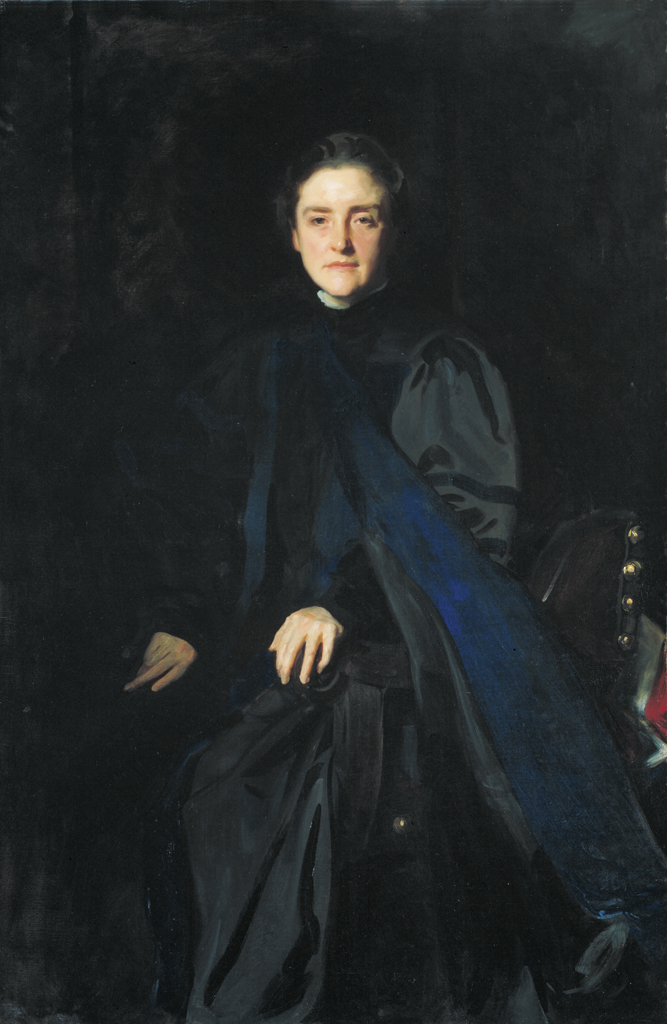
M. Carey Thomas (1857-1935) (President, 1894-1922)
John Singer Sargent, 1899
Oil on canvas, 147.32 cm x 96.52 cm
X.205
Among the College’s presidents, the legacy of M. Carey Thomas is the best-known and most controversial. An ambitious suffragist and administrator, Thomas's commitment to the cause of education was derived from personal experience. After graduating from Cornell University in 1877, Thomas began graduate work at two different institutions, but was denied a degree from either because of her gender. She persisted and received her PhD summa cum laude from the University of Zurich in 1882. At Bryn Mawr, Thomas first applied for the presidency, but was appointed as a professor and Dean of the College. With the financial backing of her sponsor and later domestic partner Mary E. Garrett, she attained the presidency in 1894. Her autocratic rule yielded a period of unparalleled financial, academic, and physical growth. Thomas strove for a women’s education that would rival in quality the best male universities, and she enacted her vision at Bryn Mawr in uncompromising terms-- that is, for white, economically-privileged women. Thomas’s deeply racist, anti-Semitic, and classist beliefs informed her harmful, exclusionary actions at the College. All of these convictions constituted her vision and have remained formative to Bryn Mawr’s identity.
The portrait of M. Carey Thomas is visually similar to contemporary portraits of male college presidents, but transgressive for its particular subject. There would have been no precedent for depicting a woman in academic regalia, and the commission of celebrated portraitist John Singer Sargent to develop one is a particularly assertive claim for this woman’s membership in an exclusively male club. Whereas Sargent’s other portraits of women are set in domestic spaces and softened by swathes of shimmering fabric, mild colors, reserved or averted gazes, and vulnerable postures, Thomas absolutely dominates this painting. Her face and hands carry the compositional weight, emerging luminously from the dense black and blue passage of her academic robes. Tensely posed, her hands twist in her lap or commandingly clutch the throne-like chair in which she sits. Although her face appears youthful, it is not delicate, and her direct gaze outward is severe and authoritative. Thomas travelled to London and sat for the painter over a six-day period. She was immensely satisfied with the result, which was unveiled at Bryn Mawr in November 1899 and won the Grand Prix at the Paris Universal Exposition in 1900.