Thomas, M. Carey to Asa Wing. 8 December 1920.
1 2020-03-04T15:51:22+00:00 Alicia Peaker fa9ce5cf6cff641fdb630497ef4559c09dbe1858 8 1 Thomas, M. Carey to Asa Wing. 8 December 1920. 1DB2 Series 1, Subseries 2, Box 26, Letterbook 67. M. Carey Thomas Papers, Official Outgoing Correspondence. Bryn Mawr Special Collections. Bryn Mawr, Pennsylvania. plain 2020-03-04T15:51:22+00:00 Desc: 00000101 Name: 00000101 Alicia Peaker fa9ce5cf6cff641fdb630497ef4559c09dbe1858This page is referenced by:
-
1
2020-03-04T15:51:23+00:00
Anti-semitism
3
plain
2020-04-30T20:50:34+00:00
Although Thomas's Quaker upbringing instilled in her a respect for the biblical Jews of the Old Testament, her attitude towards the few Jews she encountered in real life was shaped by her elite background and intensifying anti-Semitism in America and Europe. At the Bryn Mawr School in Baltimore, which Thomas and her friends founded and managed, the enrollment of a young Jewish applicant named Sadie Szold at the school in 1885 triggered conflict between Thomas and Mary Garrett. Garrett wished to admit Szold, and did so despite Thomas's bitter arguments against it. Thomas was further enraged when Garrett decided to open enrollment to Jews the following year, and responded by instating an unofficial quota at the school.
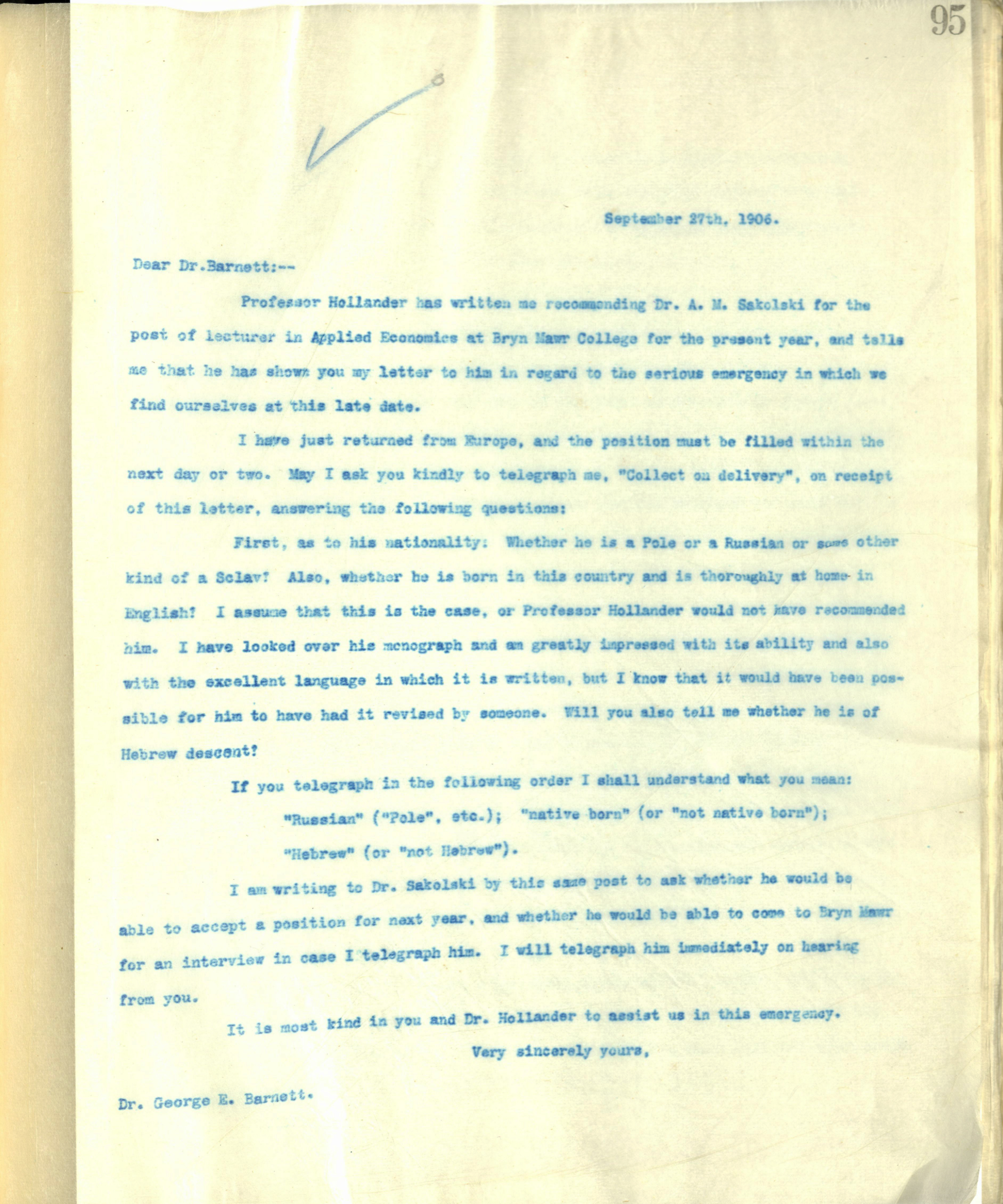
At Bryn Mawr College, because she dealt with the Board of Directors rather than her circle of friends, Thomas's desires were more constrained. Yet she exercised an impressive level of control over the school through her personal involvement in nearly all of its administrative activities. Thomas searched for and hired new faculty members herself, and one of her greatest concerns was that the College not hire Jewish professors. The following letter is one case in her correspondence which demonstrates this belief. Seeking to fill a vacancy in the Economics department, Thomas sent a letter to Johns Hopkins professor Dr. George E. Barnett inquiring about the candidate Dr. A.M. Sakolski. Although she was impressed by Sakolski's work and asked him to interview at the College, his surname seemed to disturb her, prompting her investigation into his nationality and ethnic background. In the meantime, Thomas received a recommendation for a candidate with an Anglo-Saxon name, and she subsequently withdrew Sakolski's invitation to interview. "It is much more satisfactory," she wrote to the professor who had recommended the new candidate, "to have a faculty made up as far as possible of our own good Anglo-Saxon stock." (M. Carey Thomas to Dr. George E. Barnett. 27 September 1906; Helen Lefkowitz Horowitz, The Power and Passion of M. Carey Thomas (University of Illinois Press, 1999)).September 27th, 1906.
Dear Dr. Barnett--
Professor Hollander has written me recommending Dr. A. M Sakolski for the post of lecturer in Applied Economics at Bryn Mawr College for the present year, and tells me that he has shown you my letter to him in regard to the serious emergency in which we find ourselves at this late date.
I have just returned from Europe, and the position must be filled within the next day or two. May I ask you to kindly telegraph me, "Collect on delivery" on receipt of this letter, answering the following questions:
First, as to his nationality: Whether he is a Pole or a Russian or some other kind of a Sclav [sic]? Also, whether he is born in this country and is thoroughly at home in English? I have looked over his monograph and am greatly impressed with its ability and also with the excellent language in which it is written, but I know that it would have been possible for him to have had it revised by someone. Will you also tell me whether he is of Hebrew descent?
If you telegraph in the following order I shall understand what you mean:
"Russian" ("Pole", etc.); "native born" (or "not native born"); "Hebrew" (or "not Hebrew").
I am writing to Dr. Sakolski by this same post to ask whether he would be able to accept a position for next year, and whether he would be able to come to Bryn Mawr for an interview in case I telegraph him. I will telegraph him immediately on hearing from you.
It is most kind in you and Dr. Hollander to assist us in this emergency.
Very sincerely yours,
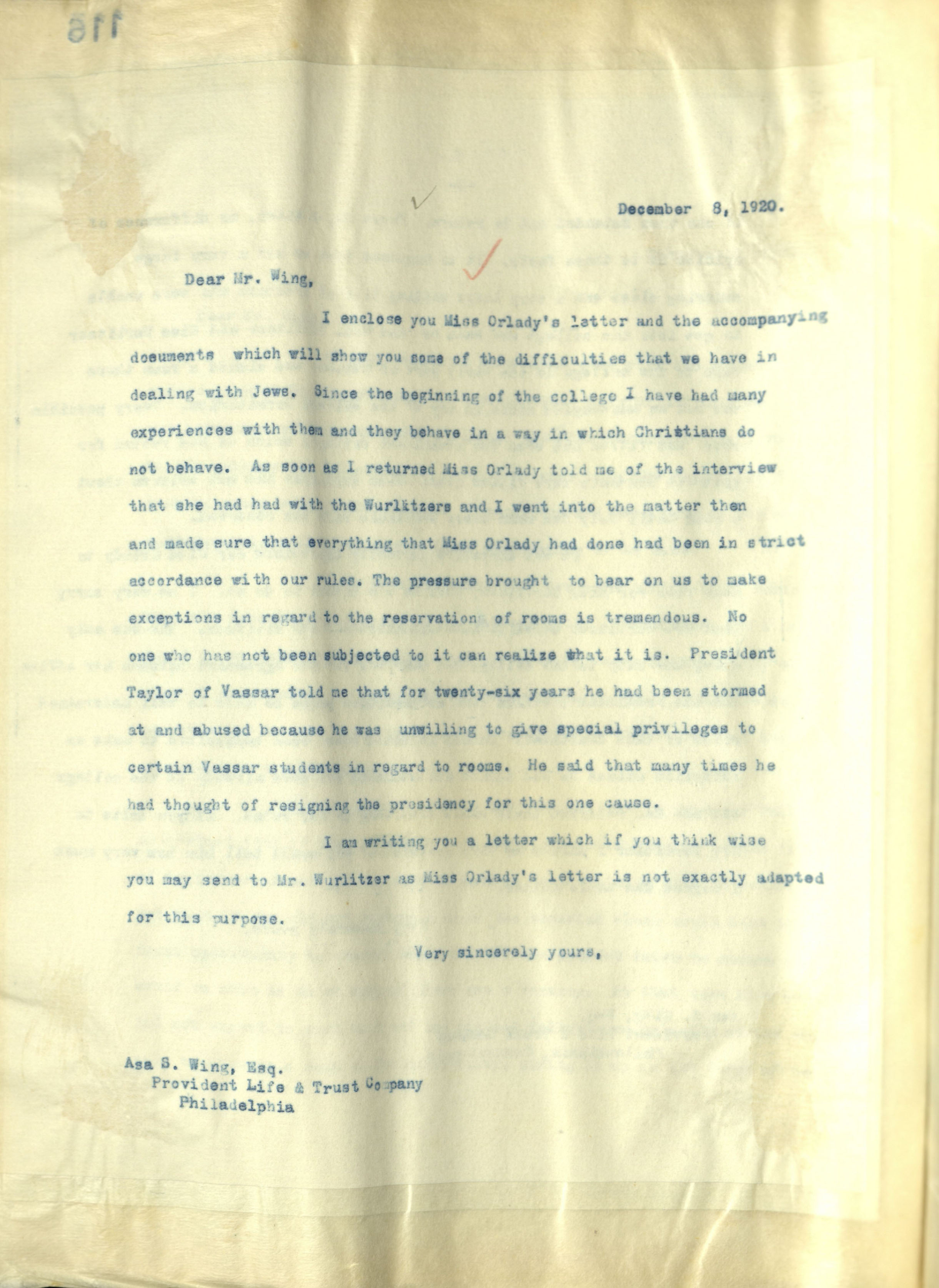
December 8, 1920.
Dear Mr. Wing,
I enclose you Miss Orlady's letter and the accompanying documents which will show you some of the difficulties that we have in dealing with Jews. Since the beginning of the college I have had many experiences with them and they behave in a way in which Christians do not behave. As soon as I returned Miss Orlady told me of the interview that she had had with the Wurlitzers and I went into the matter then and made sure that everything that Miss Orlady had done had been in strict accordance with our rules. The pressure brought to bear on us to make exceptions in regard to the reservation of rooms is tremendous...