Thomas, M. Carey to Mrs George W. Kendrick. 23 September 1901.
1 2020-03-04T15:51:31+00:00 Alicia Peaker fa9ce5cf6cff641fdb630497ef4559c09dbe1858 8 1 Thomas, M. Carey to Mrs George W. Kendrick. 23 September 1901. 1DB2 Series 1, Subseries 2, Box 4, Letterbook 23. M. Carey Thomas Papers, Official Outgoing Correspondence. Bryn Mawr Special Collections. Bryn Mawr, Pennsylvania. plain 2020-03-04T15:51:31+00:00 Desc: 00000094 Letterbox no. 23 MCt official papers Alicia Peaker fa9ce5cf6cff641fdb630497ef4559c09dbe1858This page is referenced by:
-
1
2020-03-04T15:51:31+00:00
Jessie Fauset
2
plain
2020-04-30T20:30:35+00:00
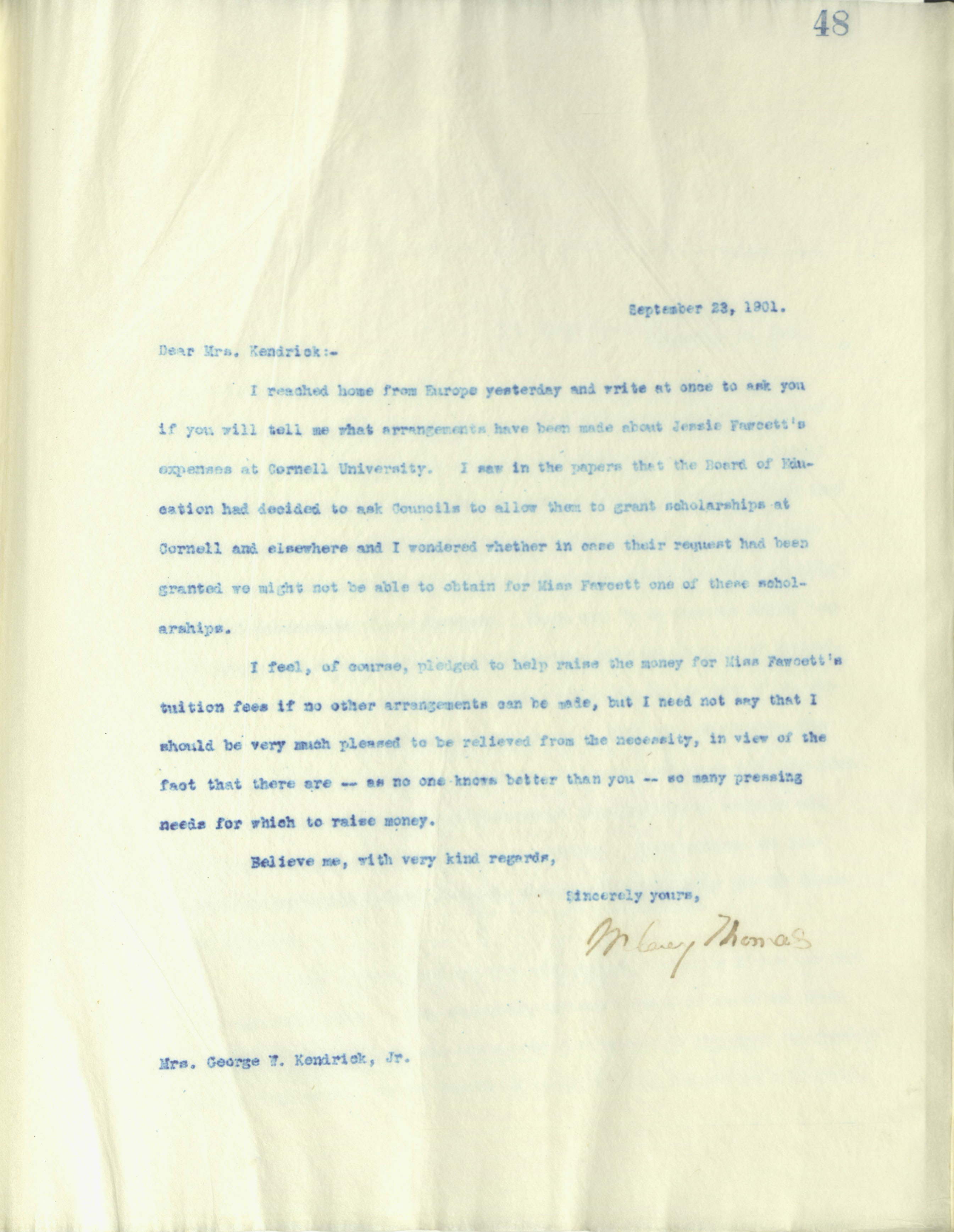
Jessie Redmon Fauset was a celebrated writer and editor in the Harlem Renaissance. In 1901, she was also the first Black student to enroll at Bryn Mawr. Per an agreement between the two institutions, her academic excellence at the Philadelphia High School for Girls won her a full scholarship and a guaranteed spot at the College. However, upon discovering that Jessie Fauset was a Black woman, M. Carey Thomas quietly arranged for her to attend Cornell University instead. Thomas personally, albeit grudgingly, raised the funds for Fauset's Cornell tuition. In the following 1901 letter to Mrs. George Kendrick, she wrote "I feel, of course, pledged to help raise the money for Miss Fawcett's [sic] tuition fees if no other arrangements can be made, but I need not say that I should be very much pleased to be relieved from the necessity, in view of the fact that there are, as no one knows better than you, so many pressing needs for which to raise money." Of course, Thomas was not alone in her beliefs, and many of her contacts expressed sympathy for her decision to remove Fauset through their donations to Fauset's tuition at Cornell.Dear Mrs. Kendrick-
I reached home from Europe yesterday and write at once to ask you if you will tell me what arrangements have been made about Jessie Fawcett's [sic] expenses at Cornell University. I saw in the papers that the Board of Education had decided to ask Councils to allow them to grant scholarships at Cornell and elsewhere and I wondered whether in case their request had been granted we might not be able to obtain for Miss Fawcett [sic] one of these scholarships.
I feel, of course, pledged to help raise the money for Miss Fawcett's [sic] tuition fees if no other arrangement can be made, but I need not say that I should be very pleased to be relieved from the necessity, in view of the fact that there are -- as no one knows better than you-- so many pressing needs for which to raise money.
Believe me, with very kind regards,
Sincerely yours,
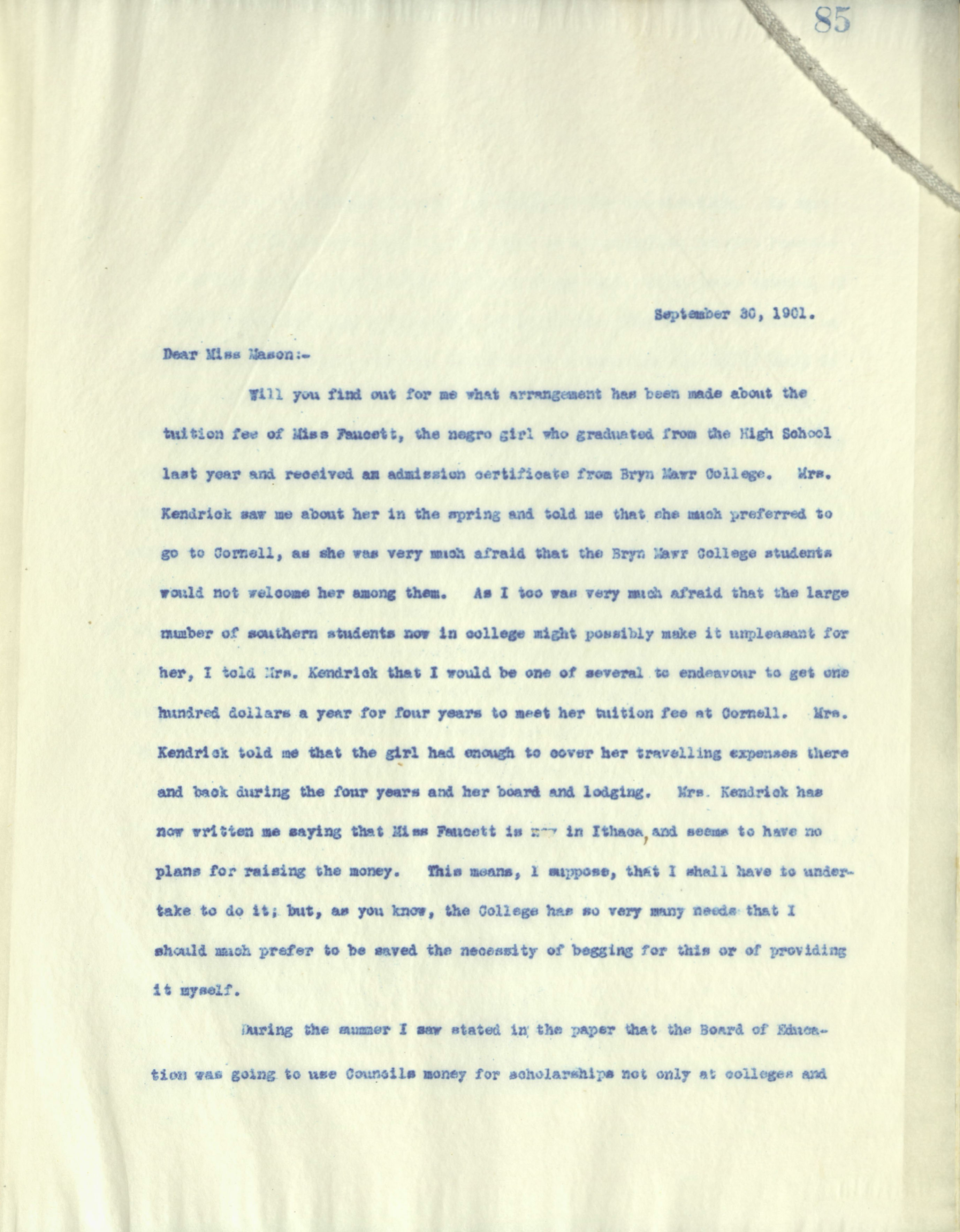
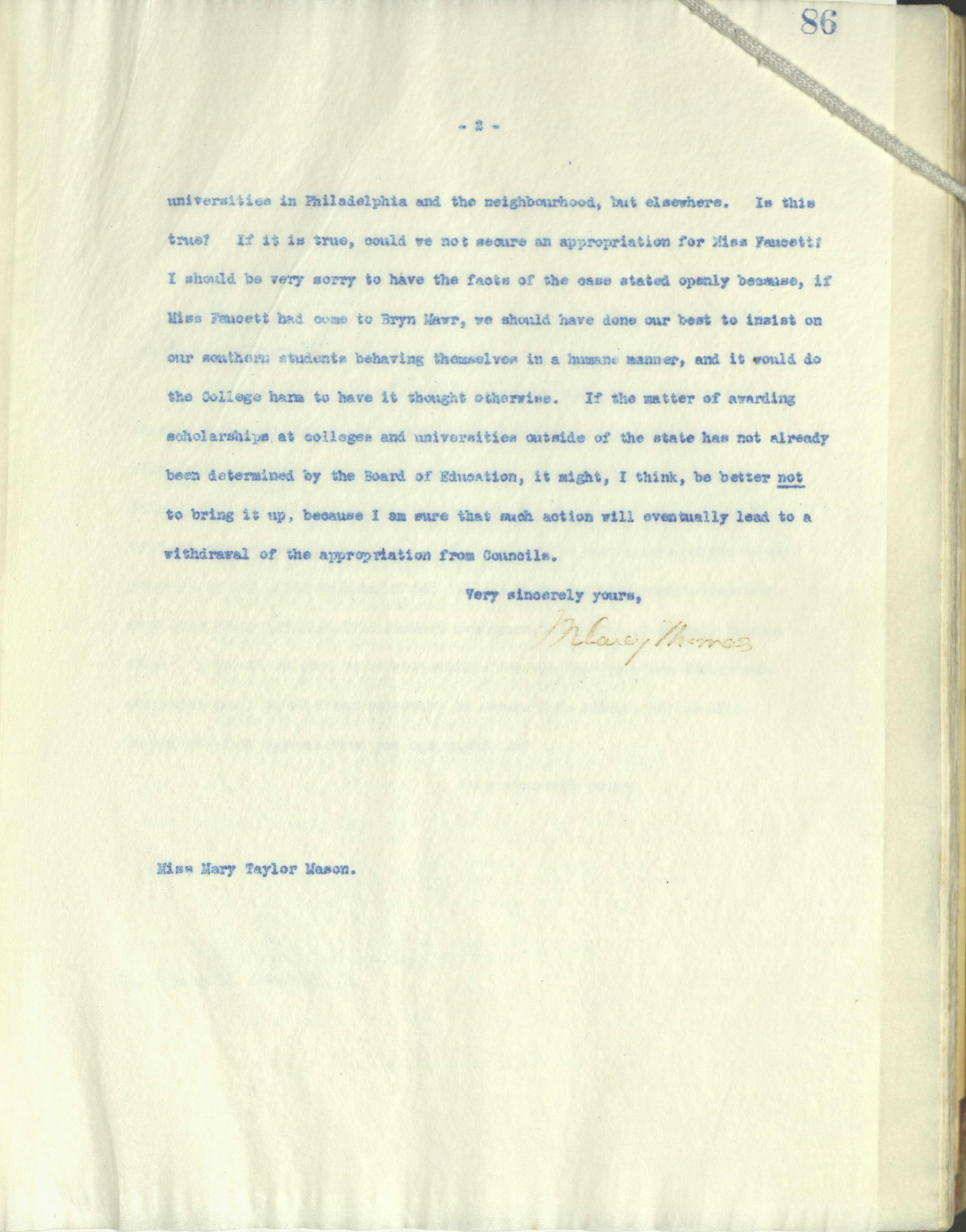
Extant correspondence in Thomas's letter books pertaining to the removal of Jessie Fauset is scant. The majority are letters soliciting funds to help Thomas cover Cornell's tuition fees. The following letter to Miss Mary Taylor Mason (below) seems to lie about the circumstances under which Fauset was diverted from Bryn Mawr and even claims that it was her wish, not Thomas's, to attend school at Cornell. Mason (Class of 1892) was on the committee of the Students' Loan Fund at Bryn Mawr College and a member of the Philadelphia Board of Education from 1899-1903, which is why Thomas writes to her about the possibility of obtaining a scholarship from the Board to cover Fauset's living expenses.
reflects the paucity of documentation, and possibly the deliberate erasure, of this episode in her papers.
Perhaps recalling the scandal which transpired at the Bryn Mawr School only six years before, Thomas seems to have dealt with the matter discreetly. Thomas's conclusion to her letter cautions Miss Mason against stating "the facts of the case...openly" and reminds her of the potential damage to the College's reputation if it appeared that the College was not behaving humanely:"should be very sorry to have the facts of the case stated openly because, if Miss Fawcett [sic] had come to Bryn Mawr, we should have done our best to insist on our southern students behaving themselves in a humane manner, and it would do the College harm to have it thought otherwise."
There is no record of Mrs. George Kendrick informing Thomas that Fauset wished to go to Cornell, nor is there evidence that Thomas felt sympathy, as she purports to feel in the above letter, for the plight of a young Black woman faced with the College's racial hostility. Certainly, her eugenicist beliefs and derogatory comments about Black individuals in private correspondence attest to otherwise. There is also Thomas's dubious claim about a "large number of southern students" at the school, which can be statistically disproven. In the school year of 1898-1899, merely 31 students out of the 287 undergraduates at Bryn Mawr were from "southern" states, and in 1906-1907, the number dwindled to 30 out of 362 undergraduates. (Thomas neglected to compose President's Reports between 1899 and 1906.) This is certainly not an issue of key financial stakeholders. Yet focusing on this misses the point, as both parties likely understood the "southern students" concern as fairly negligible, and that the racial anxiety which Thomas's language both implies and masks by displacing her racism onto the student body was likely shared by all involved parties.
In 1926, Thomas would repeat a similar concern in a letter to her successor Marion E. Park, warning that the College risked "losing much loyalty, financial support, and very many highly desirable white students from our home state of Pennsylvania, New York, and other Middle Atlantic states, and practically all our Southern students" if the College chose to admit Black students as residents. As Grace Pusey points out, this statement reflects Thomas's belief that "modeling social reform was less vital to the College’s mission than securing financial backing bequeathed to the institution by white students and families" (Black at Bryn Mawr).
Bryn Mawr College and Vassar were the last two Seven Sisters to admit Black students.
Sources:
Bryn Mawr College, "Bryn Mawr College Annual Report , 1894-95." (1895). Annual Reports of the President of Bryn Mawr College. 2. https://repository.brynmawr.edu/bmc_annualreports/2
Bryn Mawr College, "Bryn Mawr College Annual Report , 1906-07" (1907). Annual Reports of the President of Bryn Mawr College. 3. https://repository.brynmawr.edu/bmc_annualreports/3
Goff, Florence. "In Black and White." Bryn Mawr Alumnae Bulletin. September 2015. http://bulletin.brynmawr.edu/features/hp-primary-feature/in-black-and-white-4/.
Horowitz, Helen Lefkowitz. The Power and Passion of M. Carey Thomas 1st ed. New York: Alfred A. Knopf, 1994.
Perkins, L. (1997) The African American Female Elite: The Early History of African American Women in the Seven Sisters Colleges, 1880-1960, Harvard Educational Review, 67:4, 178-756.For other examples of the effects of Thomas's racist and eugenicist beliefs, see
Dr Mott-Smith
Thomas, M. Carey to Dean Hilda W. Smith. 2 November 1920.
Thomas, M. Carey to Marion E. Park. 20 October 1926.