Personality and Class
What makes us who we are? Just as today we might turn to personality tests and horoscopes to explain our dispositions and destinies, our early modern counterparts looked to the four temperaments. Decided by the configuration of planets at birth, an excess of a bodily humor could account for one's disposition and life trajectory. One's disposition also experienced day-to-day fluctuations, influenced by the movement of the planets and changes in environment or diet. These dispositions or temperaments, in turn, could be used as explanations for a rigidly hierarchical society. Artists could attribute the hardship of beggars and peasants to their phlegmatic, and therefore idle, or choleric, and therefore dangerous, qualities. A privileged soldier's choleric violence, in contrast, could be celebrated as the strong will of Napoleon—or does the phlegmatic gesture of his idle hand undermine this reading?
This page has paths:
- Tour the Exhibition Carrie Robbins
Contents of this tag:
- After Paul Delaroche (French, 1797-1856), Napoleon Bonaparte (1870-75), after painting of 1838. Engraving; Gift of Abby A. K. Turner Van Pelt Grimscom, Class of 1952, Katherine Drexel Van Pelt Beaver, and Charles B. P. Van Pelt; VP.786.
- Delaroche
- van Vilet
- Vivarès
- Worlidge_van Vilet
- François Vivarès (French, 1709-1780), after Rembrandt Harmensz. van Rijn (Dutch, 1606-1669); Beggar Seated Warming His Hands at a Chafing Dish (1850-1900). Etched in reverse, copy no. 5 after etching of c. 1630, signed in plate, X.814
- Jan Georg van Vilet (Dutch c. 1610-1668), Pedlar (18th- or 19th- century restrike?). Etching on woven paper, state v/v, signed in plate, X.899
- Thomas Worlidge (English, 1700-1766), after Rembrandt Harmensz. van Rijn (Dutch, 1606-1669); Beggar Seated on a Bank (18th- century). Etched copy in reverse, copy no. 14 after etching of 1630, signed in plate, X.811
- Jan George van Vilet (Dutch, c. 1610-1668), Beggar with Two Crutches (18th- or 19th- century restrike?). Etching on wove paper, state iv/iv, signed in plate, X.901
This page references:
- John Sartain (English-American, 1808-1897), after Christian Schussele (French-American 1824-1879), A Reminiscence of the Opera (1851). Mezzotint, Gift of John Freas, SAR.102
- Jonas Suyderhoef (Dutch, c. 1613-1686), after Adriaen van Ostade (Dutch, 1610-1685); The Big Broom, or Peasants Under an Arbour to the Right of an Inn (mid-late 17th century). Engraving, state ii/iv, signed in plate, Gift of Richard E. Bishop in memory of
- Lynd Ward (American, 1905-1985), Preachers (1943). Mezzotint; published as no. 627 in Desiderius Erasmus (Dutch, 1469-1536) Moriae encomium, or, The Praise of Folly (New York: Limited Editions Club, 1943); Gift of Jacqueline Koldin Levine (Class of 1946)
- Francesco Curti (Italian, 1603-1607), after engraving by Agostino Carracci (Italian, 1557-1602) of drawing by Francesco Vanni (Italian 1563-1610); St. Jerome in Meditation (c. 1595). Engraved copy in reverse, X.959
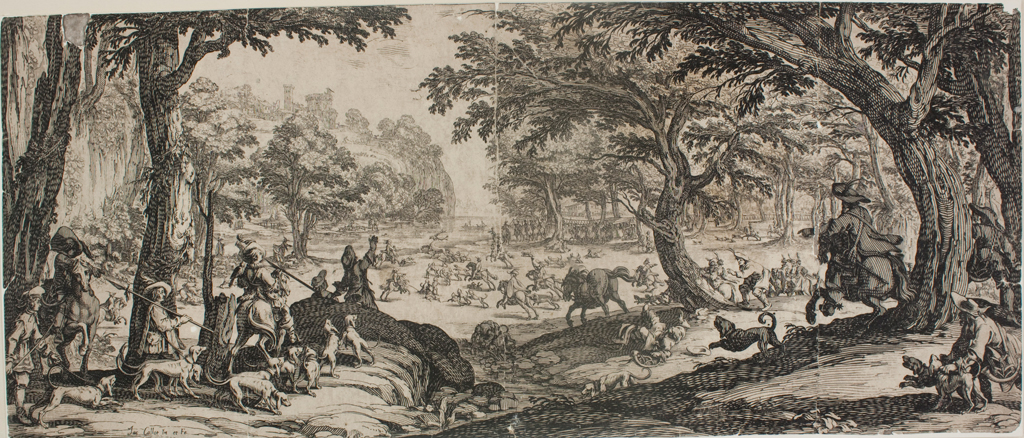
- Jacques Callot (French 1592-1635), The Large Hunt (1619). Etching; state i/iv, signed in plate; Gift of Howard L. Gray, Professor of History, 1915-1940; 1946.16.
- After Paul Delaroche (French, 1797-1856), Napoleon Bonaparte (1870-75), after painting of 1838. Engraving; Gift of Abby A. K. Turner Van Pelt Grimscom, Class of 1952, Katherine Drexel Van Pelt Beaver, and Charles B. P. Van Pelt; VP.786.
- Robert von Neumann (German-American, 1888-1976), The Four Net Menders (1934, published by the Woodcut Society, 1950). Woodcut; Gift of Mary Patterson McPherson, President of Bryn Mawr College, 1978-1997; 2018.35.26.
- Jacques Callot (French, 1592-1635), Captain of the Barons (1622). Etching on wove paper, unique state, signed in plate, X.865
- Wenceslaus Hollar (Bohemian-English, 1607-1677), Salmon Fishing (1671). Etching, state ii/ii, signed in plate, X.352
- Clare Leighton (English-American, 1898-1989), Stooking: August (1978). Wood engraving, second edition 28/100, signed in pencil below image, Gift of Jacqueline Koldin Levine (Class of 1946) and Howard H. Levine, 2012.27.383
- Master of the Die (Italian, active c. 1530-1560), after Giulio Romano (Italian 1499?-1566), Two gladiators fighting in front of an arch (1530-1560). Engraving, initialed in plate, Gift of Abby A. K. Turner Van Pelt Griscom (Class of 1952), Katherine Drexe
- Callot
- Albrecht Dürer (German, 1471-1528), The Four Horsemen of the Apocalypse (1511). Woodcut, published as plate 3/16 in Apocalypsis cum figuris (Late edition, 1511, of The Apocalypse, 1497/1498), initialed in plate, Gift of Marcus Stanley, 2012.15.1
- John Sloan (American, 1871-1951), Man Monkey (1905). Etching, edition of 100, state vi/vi, signed in plate, Gift of Richard E. Bishop in memory of Mary E. Harrington, 1962.143
- Curti_Davies
- Arthur Bowen Davis (American, 1862-1928), Introvert (1919-1920). Soft-ground etching and aquatint; edition of 25, state ii/ii, stamped by estate; Gift of Jacqueline Koldin Levine (Class of 1946) and Howard H. Levine; 2012.27.163
- After Lucas Leyden (Netherlandish, 1494-1533) The Musicians (1524). Engraving, monogram in plate, X.415
- Delaroche
- François Vivarès (French, 1709-1780), after Rembrandt Harmensz. van Rijn (Dutch, 1606-1669); Beggar Seated Warming His Hands at a Chafing Dish (1850-1900). Etched in reverse, copy no. 5 after etching of c. 1630, signed in plate, X.814
- Hirschfeld_Sartain
- Jan Georg van Vilet (Dutch c. 1610-1668), Pedlar (18th- or 19th- century restrike?). Etching on woven paper, state v/v, signed in plate, X.899
- Master_Ward_Dürer
- Thomas Worlidge (English, 1700-1766), after Rembrandt Harmensz. van Rijn (Dutch, 1606-1669); Beggar Seated on a Bank (18th- century). Etched copy in reverse, copy no. 14 after etching of 1630, signed in plate, X.811
- Suyderhoef
- Jan George van Vilet (Dutch, c. 1610-1668), Beggar with Two Crutches (18th- or 19th- century restrike?). Etching on wove paper, state iv/iv, signed in plate, X.901
- von Neumann
- Thomas Waterman Wood (American, 1823-1903), His Own Doctor (1883). Etching; signed in plate and below in pencil; Gift of Abbey A. K. Turner Van Pelt Grimscom (Class of 1952), Katherine Drexel Van Pelt Beaver, and Charles B. P. Van Pelt; VP.845.
- Worlidge_van Vilet
- Rembrandt Harmensz. van Rijn (Dutch, 1606-1669). Peasant Family on the Tramp (18th century restrike). Etching on wove plate, state ii/iii, X.319